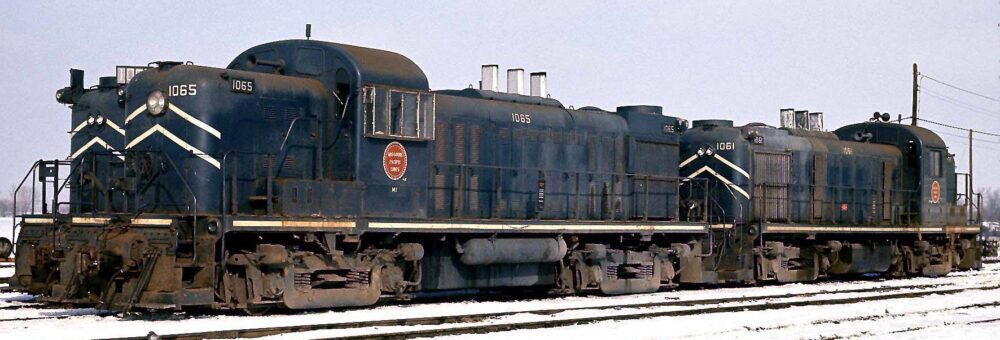
Like most American railroads, the Missouri-Illinois Railroad (M-I) emerged from a patchwork of small, fiercely competitive local lines. Its primary north–south backbone began in 1887 as the Mississippi River & Bonne Terre Railway (MR&BT), a 3-foot narrow-gauge line hauling lead-belt ore to the smelter at Herculaneum. Soon after opening, the MR&BT converted to standard gauge to allow interchange with connecting railroads—an essential step for survival.
The east–west Illinois Southern Railway (IS) reached the Mississippi in 1902, using a transfer boat between Kellogg, Illinois, and Little Rock Landing, just north of Ste. Genevieve, Missouri. It continued west to Bismarck, where it interchanged with the Iron Mountain Railroad (later Missouri Pacific), giving shippers a way around the congestion of St. Louis’ freight yards. The IS and the MR&BT crossed—and often quarreled—at Derby, Missouri. A string of financial disasters eventually sank the IS: its owner landed in prison, it lacked rolling stock to generate revenue, and it had no access to capital. After two receiverships, the IS shut down in 1919, prompting several major shippers to form the Missouri-Illinois Railroad and purchase the line out of foreclosure.
Even though it served rich Illinois farmland and Missouri’s productive Lead Belt, the M-I didn’t turn steady profits until oil was discovered along its Illinois right-of-way. Missouri Pacific (MoPac) gained control of both the MR&BT and the M-I in 1929 and operated them jointly. The MR&BT was formally dissolved in 1945, with all assets absorbed into the M-I. While equipment carried M-I reporting marks, the railroad proudly used the herald of its parent—the MoPac buzzsaw
The map below illustrates the full extent of the Missouri–Illinois Railroad as it stood in 1929.

By 1950, the Missouri–Illinois Railroad (M-I) handled a remarkably balanced mix of traffic for a system with fewer than 200 miles of track. Its carloads came from coal mines, grain elevators, Illinois oil fields, and Missouri’s limestone and lead operations. Despite expectations, Missouri agriculture never produced major business for the M-I; the rocky soils of the Lead Belt couldn’t compete with the rich farmland of Illinois’ “Little Egypt.” Grain also moved predominantly south to Gulf ports, making the Illinois Central the natural carrier for that traffic rather than the primarily east–west M-I.
For its size, the M-I punched well above its weight. At various points it served the world’s richest lead deposits, the world’s largest lead smelter (St. Joe Lead in Herculaneum), the world’s largest float-glass plant (PPG Works No. 9 in Crystal City), and the world’s largest lime plant (Mississippi Lime in Ste. Genevieve). The M-I name disappeared in 1978 when MoPac consolidated seven subsidiaries under the parent corporation. Customers still enjoyed the approachable, short-line service culture of M-I employees, while benefiting from the stronger management, equipment, and safety standards of Missouri Pacific. Four years later, MoPac itself was absorbed by Union Pacific, bringing an end to the familiar red-and-white buzzsaw herald.
Special thanks to Charles Duckworth—well known in the hobby—whose book The Missouri–Illinois Railroad: Missouri Pacific’s Route Through the Lead Belt and Little Egypt (Missouri Pacific Historical Society, 2020) remains the definitive reference on this often overlooked railroad.
