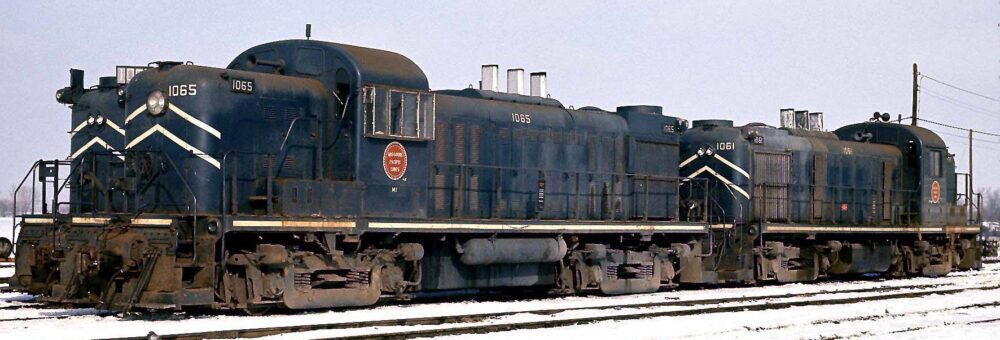
Operations on the Ste. Genevieve subdivision started with Car Cards, but I was disappointed with the stack of thick cards and waybills falling out pockets. Hence, in 2026, I changed to a more realistic approach using a switchlist to guide switching and larger, prototypical waybills to aid in completing a switchlist.
In the “real world”, waybills were never handled by anyone who was not involved in the accounting and billing side of the railroad. They were essentially cash to the railroad and the conductor safeguarded them as such. Waybills typically remained within the caboose and were used by the conductor to prepare reports and, of course, the switchlist.
Switchlists
Most of the time, the clerk prepares the switchlists. If not, it only takes a few minutes for a crew to prepare their own.
Time can be saved by entering only the last 3 digits of the car’s road number. When cars move from the boat to Middle Yard, the destination column will denote the departing train for the Yardmaster.
Waybills
The top left of the waybill identifies the car. Just below is the car’s destination and the specific customer (Consignee). For interest only, the right side shows the shipper and its location.
Occasionally, goods are shipped to customers who do not have a dedicated rail spur. These cars are unloaded at the house track dock and the waybill will note HS TK in the Consignee section.
Each switching location has a hook to hold the crew’s clipboard (since the hooks blend in with fascia, look for the orange dot). There is also a bill box for the waybills. When switching is completed, reconcile the waybills with the cars in your train. The waybills for set outs should be left in the bill box; similarly, take the waybills for pickups with you.
Occasionally, one asks, “what about that car which isn’t on the switch list and there’s no waybill? What do I do with it?” That’s easy: “nothing!” It may be a hold for the customer and the crew can ignore it…and if it has to be moved to complete switching, just put it back in the same spot when you’re finished working the location. When an off spot is ready to be moved, the clerk will place a “Switch This Car” form in the bill box.

Empty Car Waybills
When the clerk orders an empty car for a customer, it arrives from a nearby yard (off layout) and is accompanied by an Empty Car Waybill. It will note where the car is to be spotted.


Simple Guide to Waybill Fields
Car Initials and Number Self explanatory
Kind The car type using one of the simplified AAR car codes shown in the figure above
To Identifies the city and/or station where the car is to be delivered
Consignee The specific customer to receive the car
Route When a car is destined for an off-layout location, the Route field is completed with the location of where the car leaves the layout. There are only 4 possible entries: BOAT, SLSF, DERBY JCT – BT SUB or DERBY JCT – MP. The first is pretty clear – the car is going across the Mississippi River on the ferry. The remainder are interchanges. SLSF is the Frisco interchange near the Ste. Genevieve depot. The two spurs at Derby Jct handle interchange to the MoPac (MP) and the M-I’s north/south Bonne Terre subdivision (BT SUB).
Description of Articles The car’s contents are shown here. Occasional abbreviations are C/L (car load), LCL (less than car load) or L/C (last contained).
Weight This field at the lower right is usually blank. When a red Weigh In Transit stamp is present, the Yardmaster shall weigh the car before forwarding. To the right of the C.O.D. panel is where Yardmaster finds the car’s allowable weight. This number has been pre-calculated for the weigh master from the car’s stenciled Load Limit and Light Weight. As long as the scale’s Gross Weight is less than the Allowable Weight, the car is safe and ready to move along.
Train Orders
Train orders are prepared for each job or train describing the locations to be worked and the train’s maximum tonnage. If a location is not specified to be worked, please do not work it.
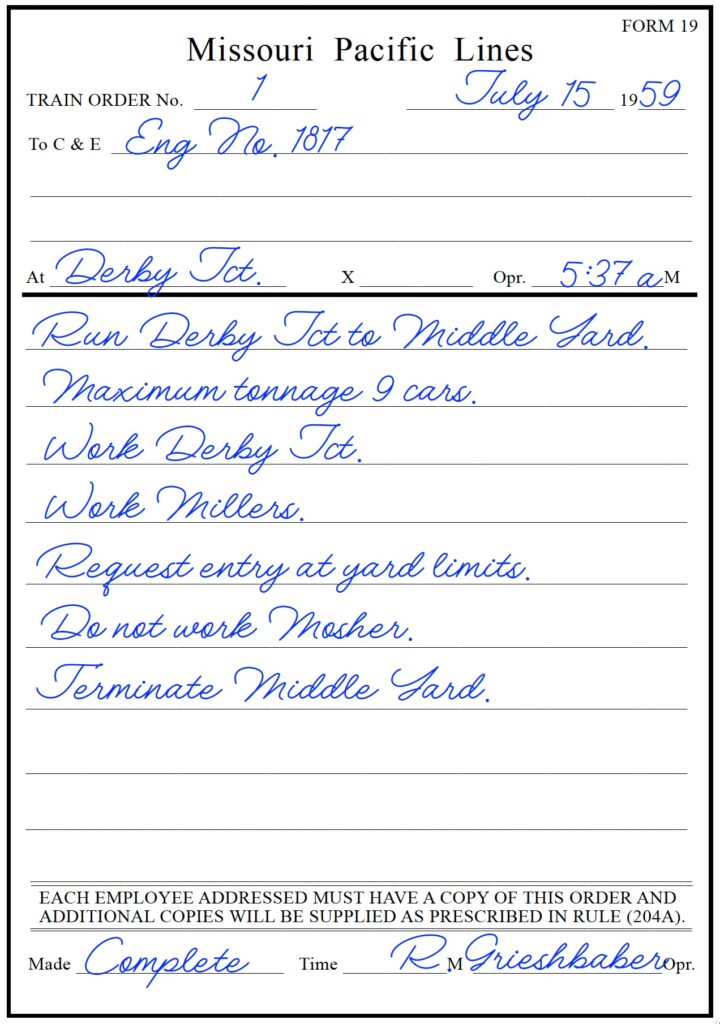
Crew Packet
Each crew (and job) has a clipboard to hold paperwork.

If you are interested in learning more about Waybills, see these links…
- Tony Thompson’s Guide to Waybills
- Resin Car Works Waybills
- Kelly Regan Prototype Waybills
- St. Charles Branch Modeling Paperwork
- Trevor Marshall Car Forwarding