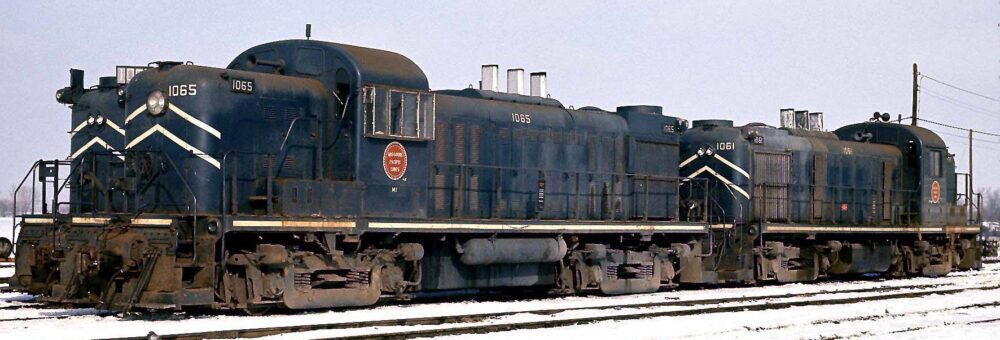
The incline crew works the ferry boat and is key to efficiently managing traffic flow on the layout as this is a crucial staging location. Most cars enter and exit the layout at this locale.
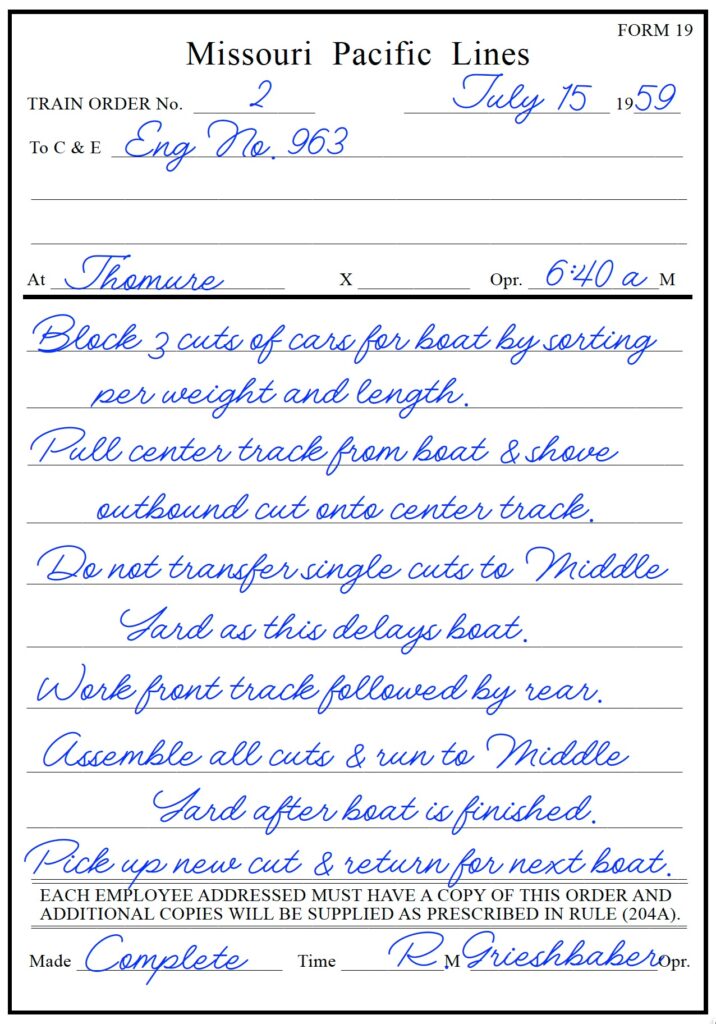
A set of train orders outline the steps needed to accomplish the crew’s tasks. They are located on your clipboard and will explain a lot – please read them in their entirety.
Depending upon the operating year, motive power is either a 2-8-0, 4-8-0 or an Alco RS3. Regardless of head end power, all use an idler car between the engine and cars to prevent damage to the incline apron from the heavy engine. At the beginning of a session, the incline crew will retrieve their power from the engine house and couple onto the idler car.
Work begins in Thomure yard with blocking of outbound cars using the multiple run-arounds and stub tracks. The ferry boat has a maximum capacity of 12 cars on 3 tracks. However, loading is dependent upon the length of the car and whether it’s loaded or MTY. We certainly want to avoid capsizing the boat or shoving any cars overboard. Each boat track is 196 scale feet long, so four covered hoppers easily fit; however, four 53’ long gondolas won’t fit. To account for weight, the following diagram shows the various acceptable permutations of track loading.

Once the cars are blocked for the 3 boat tracks, the crew backs down the incline and pulls the first cut of inbound cars from the center track and drops them in Thomure yard. Grabbing an outbound cut, they again back down the incline to shove them onto the center track. This track has now been fully worked and you’re ready for the next track. The boat captain (aka the Clerk) then re-positions the boat for the next track (typically the front, with the rear being worked last).
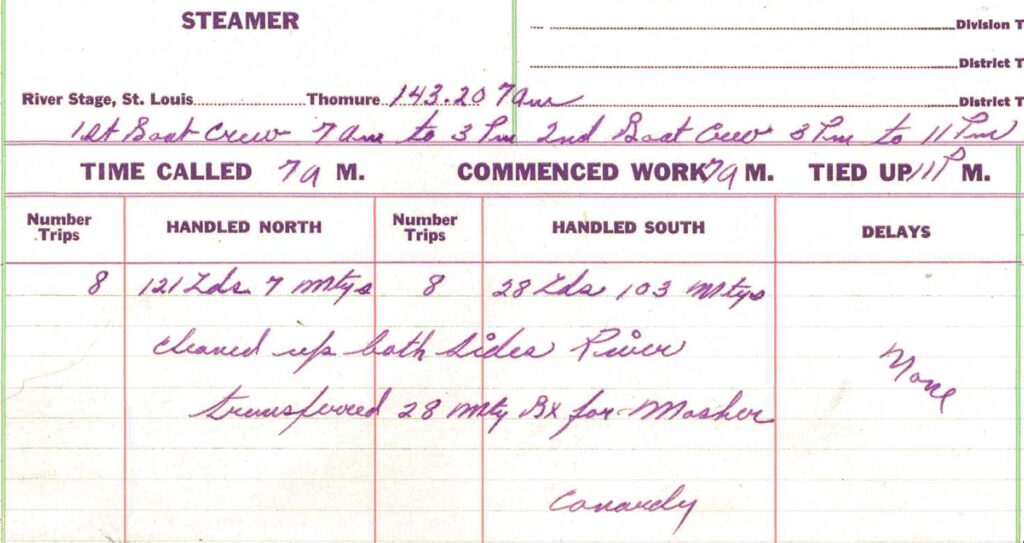
The prototype managed up to 8 round-trips per day across the river. Layout crews typically work two boat trips, and rarely a third.
Once the crew has completed loading the boat, it departs across the river to the incline at Kellogg, Illinois. The Clerk will restage the boat for its next trip. This allows time for the incline crew to transfer the inbound cars to Middle Yard (after receiving clearance from the Yardmaster). Expect to receive another set of cars for the next boat.
The incline crew can begin blocking the new outbound cars right away as to not delay the boat. Crews should always be mindful of the time spent switching and working – the boat needs to stay on schedule and delays in the yard add up. Please do not ask the Yardmaster if you can shove a single cut of cars to Middle Yard immediately after unloading a boat track. This not only interrupts the Yardmaster’s work flow, it also delays the boat. Captain Harry “Gunnie” Grieshaber is constantly fighting the river current maintaining his boat’s position and is not tolerant of delays.
Frequently Asked Questions (FAQs)
- Can I store cars on the A/D tracks to make it easier for me?
- No! The two A/D tracks (light tan colored ballast) are primarily used by Middle Yard for arriving and departing trains. However, when clear, the Incline Crew is free to use them for quick run-around moves. However, do not store cars there.
- What do I do with all these Waybills as we work the Boat?
- While blocking the outbound cuts, keep the Waybills at Thomure and place them in the “Boat Bill Box” on the fascia trim as you load the boat. Once the boat is fully loaded, hand off the stack of outbound Waybills to the Clerk. The clerk will then hand you a stack of inbound Waybills for the cars you just pulled off of the boat. Hand these to the Yardmaster when you shove cars to Middle Yard.
- How do I know whether a car is loaded or empty?
- Waybills for each outbound are in pockets assigned to each track in Thomure Yard. The waybill’s Lading section notes the contents of a car or if it is MTY.
- Why is there a semaphore signal in my way?
- The Frisco crossed the prototype at grade and the two railroads shared the cost of the tower and operator. Since the M-I was the senior line, it staffed the tower. The Clerk serves as the Tower Operator and usually sets the signals as trains arrive. However, in the event the operator is assisting others, you may need to get his/her attention.
- I’m working the boat in 1955 and the steam engine is low on water. What do I do?
- Proceed to the Water Column, swing the spout over and fill up the tender with water. The Mississippi River water is rather muddy and doesn’t steam well, so you’ll need to replenish after the first boat. Press F9 on the NCE throttle to fill; press again to stop the flow. Return the spout to its original position.
- My steam engine won’t pull the cars up the incline – what now?
- The incline grade is steep; when climbing with steam power, use extra throttle to start, then back off. Watch for wheel slip. Diesels usually don’t have a problem, but if they do, goose the throttle when you start to move.
- The inbound cars are getting in the way of my switching moves. How about I just shove each cut to Middle Yard after I pull it from the boat?
- As previously mentioned, the short answer is “no”. However, if you’re stumped and want the easy boat switching moves, click this Spoiler Alert.
- There are too many rules – I can’t remember them all!
- There are a variety of reminders and diagrams posted on the layout fascia board to help you. If you still have questions, just ask.
- There are only 7 outbound cars sitting in Thomure Yard ready for the boat. Should I wait for more to arrive before I finishing it?
- Load them & send it! Just like the prototype, the boat oftentimes sails at less-than-full capacity. And if they are all Loads, it won’t handle 12 anyway. Sometimes, it might only be half full. There are always cars across the river that need to be moved. When loading a partial boat, distribute the cars relatively evenly among the 3 tracks.
- I have a Waybill that says the car needs to be Weighed. Should I shove it to Middle Yard?
- No. That car has already been weighed at Middle Yard. The car should go to the boat. Since Waybills are re-used each session, the marking cannot be crossed out.